








Your opportunities on the international wind market
Register for free or log in to contact providers, use additional filters and tools or place your own advertisements.
- 19,526+ registered users
- About 187 Countries
- Since 2011

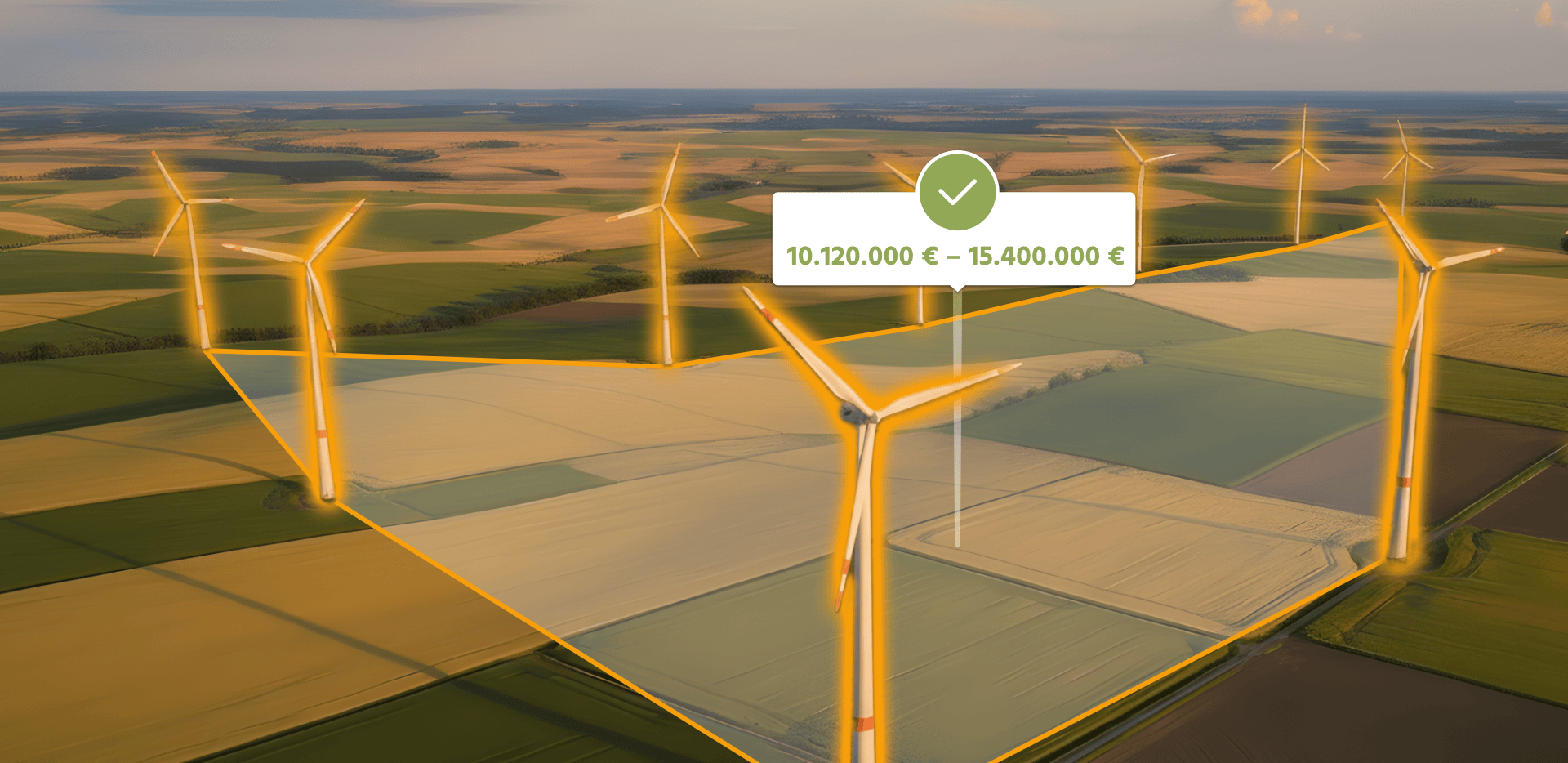






Today, wind farms are among the most important infrastructure assets in the field of renewable energies. At the same time, their assessment is much more complex than that of individual wind turbines. Investors, operators and project developers therefore need a well-founded, market-oriented valuation in order to be able to derive realistic market prices for complete wind farm portfolios.
The value of a wind farm does not result solely from the sum of the individual turbines. Economic, technical and regulatory framework conditions that influence the overall project are also decisive.
A wind farm is a long-term infrastructure project with stable cash flows, but also complex structures. In addition to the technical properties of the wind turbines, economic conditions in particular play a central role.
For a realistic valuation, the following factors are taken into account, among others:
These factors influence both the long-term revenues and the risk assessment of a wind farm from an investor's point of view.
Institutional investors view wind farms primarily as infrastructure investments with stable cash flows. Therefore, the economic performance of the overall project plays a decisive role.
Typically, the rating is based on a combination of:
The more stable the revenue structure, the more attractive the wind farm is for long-term investors such as infrastructure funds, energy suppliers or pension funds.
A reliable valuation can only be made if it is based on real market movements. In addition to business valuation models, transaction data from actual buying and selling processes is therefore crucial.
The valuation is based on, among other things:
This data enables an evaluation that is based on actual market prices – not purely theoretical model calculations.
Practical. In line with the market. Investor-oriented.
The value of a wind farm depends heavily on who values it. Different groups of buyers pursue different strategies:
A professional valuation takes these different perspectives into account and derives realistic market prices from them.
For many older wind farms, the future repowering potential plays a decisive role in the market value. Sites with good approval prospects for higher-performance plants can achieve significantly higher valuations.
The decisive factors here are:
Investors therefore often calculate not only the current operation, but also the long-term expansion options of a location.
A realistic valuation creates transparency, strengthens the negotiating position and reduces the risk of mispricing in transactions.
Operators and owners can have the current market value of their wind farm analysed free of charge. The valuation is carried out:
The goal is a realistic assessment of what a wind farm can actually achieve on the market.
The valuation of wind farms requires in-depth market knowledge, access to real transaction data and experience with international investor structures.
Knowing the market value of your wind farm creates a solid basis for sales decisions, investor negotiations and strategic portfolio optimisations.