New three-year contract covers the BNK equipment of around 130 turbines in more than 20 wind farms – including numerous new construction and ...

What Is an Aircraft Detection Lighting System (ADLS) for Wind Turbines?
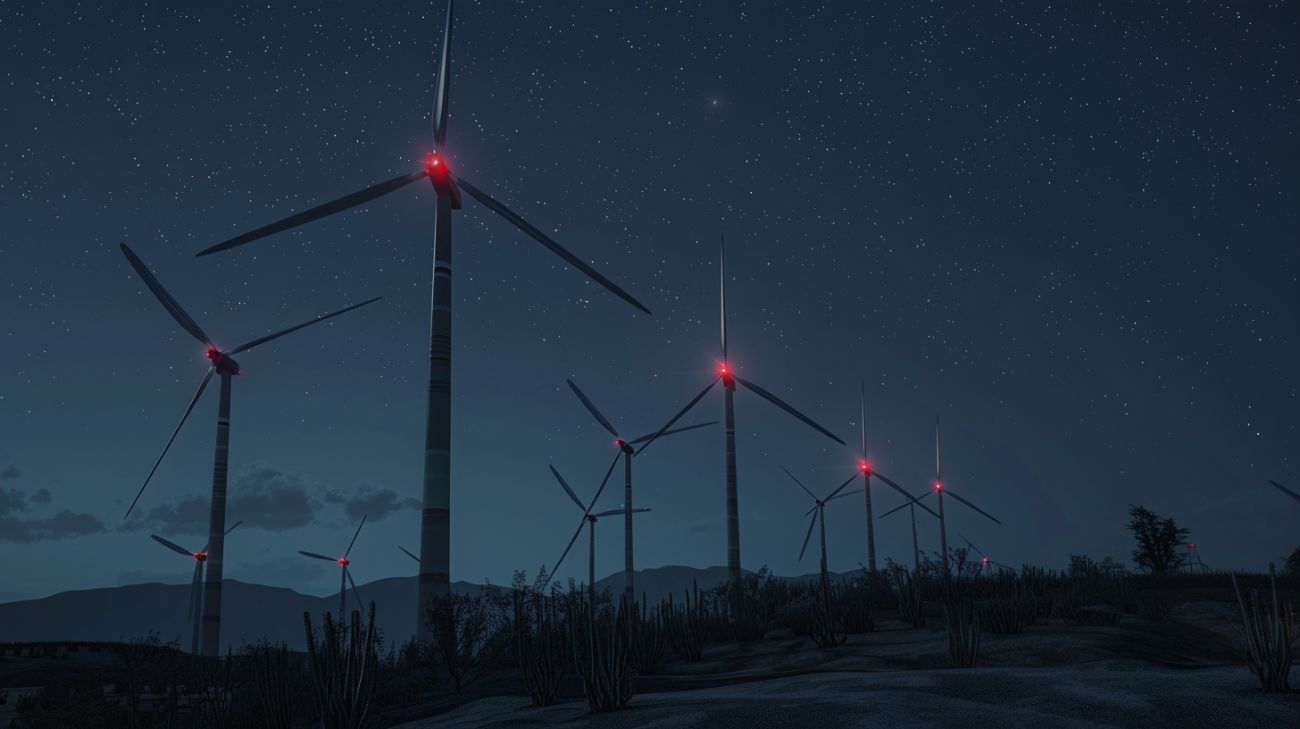
Wind turbines need aviation obstacle lights so pilots can spot tall structures at night. The issue on the ground is simple. The lights blink for hours, even when the airspace is quiet. For operators, that often turns into phone calls, complaints, and extra pressure on stakeholder work. An Aircraft Detection Lighting System, usually shortened to ADLS, changes the pattern. It monitors the airspace around a wind farm and activates the obstruction lights only when an aircraft enters a defined detection volume. When the airspace is clear, the lights stay off.
In the United Kingdom, CAP 764 is the key guidance document for wind turbines and aviation. The current version is CAP 764 Edition 7 with a version date of 17 December 2025. Edition 7 introduces requirements for aviation detection lighting systems and aligns the guidance with IEC TS 61400-29:2023 on marking and lighting of wind turbines.
The baseline legal framework for obstacle lighting away from licensed aerodromes sits in Article 222 of the Air Navigation Order. CAP 764 explains how that framework applies to wind turbines and how ADLS can be used as an operational route to reduce night-time visual impact while keeping aviation safety and compliance in focus.
CAP 764 also sets a clear boundary. ADLS for wind turbine obstruction lighting is not permitted within the obstacle limitation surfaces of a licensed aerodrome because of late detection risk.
For operators, one point matters in day to day terms. The CAA does not approve or continuously oversee an ADLS system. CAP 764 still requires CAA permission under Article 222 for ADLS operation, and it requires a declaration that minimum requirements are met before the system is used operationally.
CAP 764 treats ADLS as a safety system. It defines fail-safe behaviour and sets minimum performance expectations. The fail-safe philosophy is straightforward. Obstacle lights are on by default and the ADLS switches them off when aircraft are outside the detection volume. If the system fails, the lights remain on.
For active sensor solutions such as radar, CAP 764 gives practical requirements that shape design, commissioning, and ongoing assurance.
CAP 764 recognises two detection approaches. Active sensing detects aircraft as targets. Passive sensing relies on information transmitted by the aircraft. In parts of UK airspace, aircraft may not be required to carry or operate transponders or ADS-B. CAP 764 therefore notes that passive approaches can require additional mitigation. It references Transponder Mandatory Zones as one possible route, subject to the CAA airspace change process.
CAP 764 also puts operational responsibility where it belongs. Wind farm operators are expected to monitor the serviceability of obstacle lighting. When a lighting outage is expected to exceed 12 hours, CAP 764 advises requesting a NOTAM through the UK AIS NOTAM section.
Most ADLS discussions focus on technology. Operators care about what happens after commissioning. Coverage design, spectrum planning, commissioning evidence, logging, and stable behaviour through maintenance windows and outages. That is where proven experience reduces risk.
Light:Guard comes from Germany, a market where demand-controlled night marking has moved from option to standard practice. Light:Guard positions its ADLS as type-tested and aligned with IEC and ICAO related standards, and it references deployments beyond Germany.
For UK projects under CAP 764 Edition 7, Light:Guard also speaks directly to the UK pathway and the minimum requirements operators need to meet. Light:Guard states that it can offer both radar-based and transponder-based approaches together with its sister company Senture GmbH. That flexibility matters in the UK because the right detection method depends on local aviation context.
New three-year contract covers the BNK equipment of around 130 turbines in more than 20 wind farms – including numerous new construction and ...
Wind turbines are under constant mechanical stress. Vertical ladders, crane systems and service lifts provide daily access for maintenance and repair. ...
Light:Guard GmbH has implemented a pilot project for an Aircraft Detection Lighting System (ADLS) at the Sønder Bork wind farm in Denmark. Over a ...
The digital transformation is giving the onshore and offshore industry an additional boost. At WindEnergy Hamburg from 22 to 25 September 2026, ...