Since 1986 we develop solutions for meteorology, remote sensing, mobile Energy supply and environmental monitoring. What started as a small private ...

WindEnergy Hamburg: more thrust for offshore
Offshore wind energy is a key growth driver for renewable energies. But the challenges have increased recently. At WindEnergy Hamburg from 22 to 25 September 2026, suppliers will present their solutions for greater safety and efficiency and meet competent partners for their demanding projects.
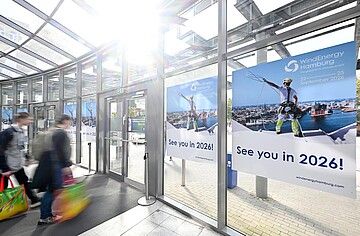
Hamburg, 09 July 2026 – A strong signal for the industry: At the beginning of the year, the British government awarded land worth almost 8.5 gigawatts to a total of twelve offshore wind energy projects – the largest single tender for offshore wind energy in European history. "With these results, Britain is regaining control of its energy sovereignty," said British Energy Secretary Ed Miliband. "This is a historic victory for all those who want Britain to have its energy supply in its own hands instead of being dependent on markets controlled by oil states and dictators." The newly awarded projects are enough to supply twelve million households with electricity. In total, investments of more than 22 billion pounds are involved. "Offshore wind is back. The oil price shock has given renewable energies a powerful boost again," says Claus Ulrich Selbach, Vice President Exhibitions at Hamburg Messe und Congress. More than 1,600 market players will present their innovations at the world's leading trade fair – and the offshore segment will be prominently represented by leading companies from all over the world.
Complex requirements, holistic view
The industry has recently had to contend with numerous challenges: In the USA, the Trump administration tried to stop offshore wind farms in some cases shortly before completion, and in Germany, the French group Total Energies is apparently currently considering the return of the concession for a project in the North Sea. The background to this is problems with grid connection. A number of players are struggling with this. In addition, there are rapidly rising costs and unclear legal and political framework conditions. The mood is correspondingly subdued, according to the results of the 17th WindEnergy trend:index, a current industry survey. However, Peter Constantin Brun, Global Segment Leader Offshore Wind at DNV, remains optimistic. "As a power generation technology, offshore wind energy has a lot to offer to meet the increasing demand for electricity through electrification and to ensure independent energy supply security," says Peter Constantin Brun. The government and regulators must promote this, for example through a stable auction design, faster permitting and grid connection procedures, and increased cross-border cooperation. "At the project level, success depends on understanding the interrelationships between the different parts of the offshore wind energy value chain. A holistic lifecycle approach is essential to manage risks and reduce costs," says the DNV manager. The independent technical consulting and certification company will present its portfolio at WindEnergy Hamburg.
Close cooperation, joint success
The expansion of offshore wind energy is technically complex and requires perfect interaction between a wide variety of players. "Cooperation is the key to the successful development of the industry – our world's leading trade fair is the ideal platform for this," says Andreas Arnhem, Director WindEnergy Hamburg. Agustin Delgado Martin, CTO of the leading Spanish energy company Iberdrola Group, takes a look at the ambitious expansion roadmap in Europe. "Common goals will only become joint action if Europe pursues a holistic approach and ensures the coordination of all strategies – not only in the energy sector, but also in the areas of digitalisation, innovation and industry. The energy transition in Europe will only succeed if ambitions are followed by concrete steps. To achieve this, we need vertical and horizontal collaboration between key players along the entire energy value chain, including the public sector, technology providers and industry." Iberdrola aims to increase its global installed offshore capacity by 3.5 gigawatts by 2028 and invest around eight billion euros in this process.
Wide range, special expertise
The entire value chain of the industry is represented at WindEnergy Hamburg – from project planning and financing to plant construction and installation to grid connection and operation. Special expertise is required, for example, in the transport, installation and maintenance of the turbines. Shipping companies have special ships ready for this purpose. These include, for example, the Belgian company Jan de Nul with its offshore installation vessels, which are in use worldwide. The Norwegian player Fred. Olsen Windcarrier has now successfully installed more than 1,100 offshore wind turbines. The Dutch company Van Oord has the largest crane ship in the world and also has large cable-laying vessels in use. And Windea Offshore, with its fleet of Commissioning Operation Vessels and Crew Transfer Vessels, ensures that the installation and maintenance teams are well accommodated and safely accessible to the wind turbines.
International design, regional connections
In the offshore industry, cooperation is underway on a global scale: Seatrium, for example, secured the contract for the BalWin 5 grid connection project at the end of 2025 as part of a consortium with GE Vernova. The project serves to feed the electricity generated by the wind farms in the North Sea into the German grid. The Singaporean company has transformed itself from a shipyard to a leading supplier of offshore wind infrastructure. "Seatrium has already delivered or is in the process of delivering offshore wind power products with a total capacity of 16 GW. This is more than the installed capacity of Singapore's power grid," reports Chris Ong, CEO of Seatrium. The importance of cooperation in the industry is also exemplified by the Gennaker project, which is being built off the coast of Mecklenburg-Western Pomerania. The wind farm developer and operator Skyborn Renewables recently put together a bundle of orders for this purpose: EEW Special Pipe Construction is supplying the monopile foundations, the transition pieces are coming from Dajin Heavy Industry, Seaway7 is responsible for transporting and installing the foundations, and a consortium of Boskalis and TKF is responsible for supplying and laying the cables between the wind farms. "Gennaker offers Mecklenburg-Western Pomerania long-term added value. Offshore wind energy has a positive impact on the ground – be it through investments, jobs or decarbonisation," says Patrick Lammers, CEO of Skyborn. At 976.5 MW, the wind farm will be the largest in the German Baltic Sea and is scheduled for completion in 2028.
Great potential, positive prospects
Offshore wind is back: This is also shown by the current billion-euro order from the grid operator 50Hertz to a consortium of Neptun Smulders Offshore Renewables and Siemens Energy, which involves a converter platform. The order shows the potential of offshore wind expansion for industrial value creation, employment and innovation in Germany, said Stefan Thimm, Managing Director of the German Wind Energy Offshore Association (BWO). "Wind energy in the North Sea and Baltic Sea not only supplies climate-friendly electricity, but also creates concrete prospects for shipyards, ports and suppliers along the entire value chain."
These and other perspectives are also the focus of WindEnergy Hamburg's freely accessible conference programme. More than 300 top speakers will discuss the major topics of the industry on six Open Stages, such as so-called Contracts for Differences (CFD), which guarantee a minimum price for electricity and thus minimise the financial risk of the operators. The Danish Energy Agency, for example, switched to the more attractive system after a tender failed spectacularly. For the 20-year funding period, around 7.4 billion euros are now available for three planned wind farms with a total capacity of 2.8 gigawatts. Other focal points will be new developments in floating wind turbines, the protection of critical infrastructure against hybrid attacks, but also the shadowing effects between individual turbines and entire wind farms, which can jeopardise the profitability of projects. "Challenges of grid connection, integration of storage technologies, AI-controlled maintenance tools: At WindEnergy Hamburg 2026, experts from politics, administration and science will meet the leading players in the industry and jointly shape the future of wind energy – offshore and onshore," says Claus Ulrich Selbach, Vice President Exhibitions Maritime & Energy at Hamburg Messe und Congress.
Since 1986 we develop solutions for meteorology, remote sensing, mobile Energy supply and environmental monitoring. What started as a small private ...
New three-year contract covers the BNK equipment of around 130 turbines in more than 20 wind farms – including numerous new construction and ...
Wind turbines are under constant mechanical stress. Vertical ladders, crane systems and service lifts provide daily access for maintenance and repair. ...
The digital transformation is giving the onshore and offshore industry an additional boost. At WindEnergy Hamburg from 22 to 25 September 2026, ...